Too few buyers, then new rules
The Amphicar sold far fewer than planned and lost money on every car. Production seems to have stopped years before the last cars were sold, and new American rules for 1968 ended it. The cars themselves have done rather better.
The Amphicar Model 770 of the 1960s. This site is about the German amphibious convertible, not amphibious vehicles in general. See the home page for what it leaves out.
When did production stop?
Hagerty UK says production, which began at the end of 1960, was stopped within three years, but so much stock had been built that the last cars were not built and sold until 1968. Hagerty UK
Der Spiegel’s 2006 article says it was all over by 1964, with 3,500 built. Der Spiegel, 2006
The same archive dates production to 1960 to 1963. Berlin-Brandenburg business archive
The Science Museum Group gives production as 1961 to 1965. Science Museum Group
Old Cars Weekly says the cars left the factory with no year on the VIN plate; the dealer stamped the year when he sold one, so a car built two years earlier could be sold as new. Old Cars Weekly
It says the last cars were probably built in 1965 or 1966, though that cannot be verified, and that a few registered as 1968 models give the ‘last production year’. Old Cars Weekly
Production years: sources differ
- The US National Park Service calls the Amphicar the only civilian amphibious passenger car ever to be mass produced, built in Germany from 1961 to 1968. National Park Service
- The same archive dates production to 1960 to 1963. Berlin-Brandenburg business archive
- Der Spiegel’s 2006 article says it was all over by 1964, with 3,500 built. Der Spiegel, 2006
- The Science Museum Group gives production as 1961 to 1965. Science Museum Group
- It says the last cars were probably built in 1965 or 1966, though that cannot be verified, and that a few registered as 1968 models give the ‘last production year’. Old Cars Weekly
- Hagerty UK says production, which began at the end of 1960, was stopped within three years, but so much stock had been built that the last cars were not built and sold until 1968. Hagerty UK
The likeliest reading is that the factory built most of the cars in the early 1960s and then sold from stock for years, with dealers stamping the year at sale. “1961 to 1968” describes the years the cars were sold as new, not necessarily the years they were made.
Why it failed
The Americans found it too small, too weak and not comfortable enough. Der Spiegel, 2006
Edle Oldtimer says Americans used to five-metre cruisers simply found it too small. Edle Oldtimer
The TECHNOSEUM adds that it needed a lot of maintenance and its performance was no longer up to date. TECHNOSEUM
Hemmings says the company and its parent, the Quandt group, lost money on every car sold. Hemmings
Edle Oldtimer says the car was always a loss-maker that Harald Quandt tolerated, and that it was ended soon after he died in an air disaster in 1967. Edle Oldtimer
The 1968 rules
No 1968-model Amphicars were imported directly into the USA, because of new EPA and Department of Transportation rules for 1968 models. With the US taking about 90 per cent of sales, that was a financial disaster for the company. IAOC history
Hemmings says that, facing new EPA and Department of Transportation rules for 1968, the company shut down because redesigning a car that lost money made no sense. Hemmings
Hagerty UK says US authorities tightened the rules on building and using amphibious cars in 1967, and the Amphicar fell foul of them. Hagerty UK
Sky HISTORY instead blames 1968 emissions standards under the Motor Vehicle Air Pollution Act. Sky HISTORY
Which rules ended it? Sources differ
- Hemmings says that, facing new EPA and Department of Transportation rules for 1968, the company shut down because redesigning a car that lost money made no sense. Hemmings
- Hagerty UK says US authorities tightened the rules on building and using amphibious cars in 1967, and the Amphicar fell foul of them. Hagerty UK
- Sky HISTORY instead blames 1968 emissions standards under the Motor Vehicle Air Pollution Act. Sky HISTORY
All three point to new American rules for the 1968 model year, but they name different ones: emissions, vehicle standards, or rules for amphibious cars in particular. With sales already small and every car sold at a loss, any of them would have been enough.
Barrett-Jackson says the German factory closed for good in 1968. Barrett-Jackson
The Berlin factory closed for good in 1968, and the leftover parts were bought by Hugh Gordon of Santa Fe Springs, California, whose Gordon Imports still supplies owners. IAOC history
Where they went
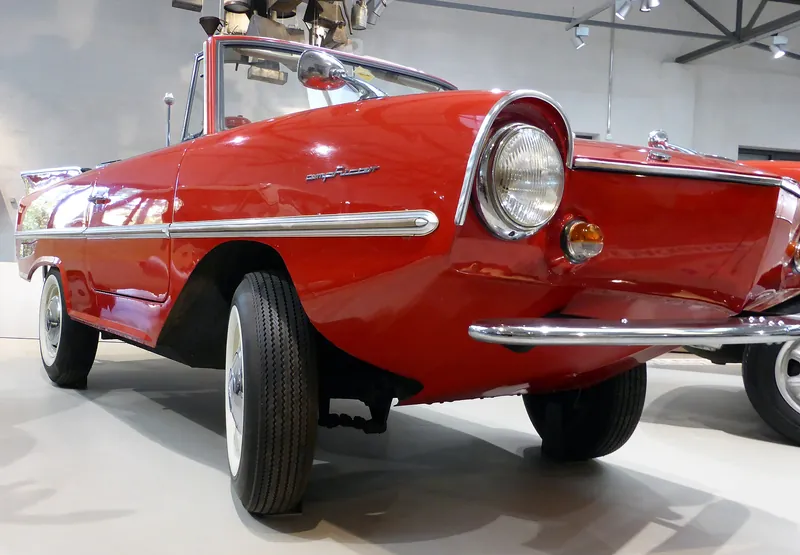
Hagerty UK says about 90 per cent of the 3,878 were sold in America, and that just 97 were right-hand drive, mostly for Britain. Hagerty UK
Hagerty’s 2016 profile says roughly 3,900 were sold from 1961 to 1968, nearly 80 per cent in North America. Hagerty, 2016
The Lane Motor Museum says 3,046 of the 3,878 went to the US and the rest were sold in Europe. Lane Motor Museum
How many were made?
Hemmings says total production ‘remains somewhat unclear’, but that most sources agree on 3,878 built between 1961 and 1967. Hemmings
Built: sources differ
- The owners’ club gives total production as 3,878, with 3,046 imported into the United States between 1961 and 1967. IAOC history
- Edle Oldtimer says only about 3,870 left the factory. Edle Oldtimer
- Sky HISTORY says ‘about 3,900’. Sky HISTORY
- The owners’ club’s ‘about’ page says ‘approximately 3,900’. IAOC
- TIME says ‘nearly 4,000’ were built between 1961 and 1968. TIME
- Slate gives 3,770 built between 1960 and 1968. Slate
- Der Spiegel’s 2006 article says it was all over by 1964, with 3,500 built. Der Spiegel, 2006
Most sources settle on 3,878, and the rounder numbers near 3,900 and 4,000 are probably the same figure rounded. Slate’s 3,770 may be a slip, given the car’s name, but we cannot prove it. Der Spiegel’s 3,500 is for the cars finished by 1964.
How many are left?
The owners’ club estimates that about 2,000 Amphicars still exist in some state, and repeats an owners’ guess that about 600 still swim. IAOC FAQ
Sky HISTORY says enthusiasts estimate that 300 to 600 seaworthy cars remain. Sky HISTORY
In 2016 the club’s president, Mike Clark, guessed there could be 500 left. Hagerty, 2016
Der Spiegel in 2009 put the number still in existence at about 1,000, mostly kept as hobby cars and rarely used. Der Spiegel, 2009
Der Spiegel in 2006 said there might be 80 left in Germany, with a few in the Netherlands and the US. Der Spiegel, 2006
Nobody keeps a full register, so these are all estimates. Taken together, perhaps half of all Amphicars survive in some form, and a much smaller number still go in the water.
Parts and prices
Hagerty’s price guide says there were once 71 Amphicar dealers in the US. Hagerty price guide
The Berlin factory closed for good in 1968, and the leftover parts were bought by Hugh Gordon of Santa Fe Springs, California, whose Gordon Imports still supplies owners. IAOC history
Gordon Imports bought up the parts stocks decades ago and has also developed improved replacement parts. Hagerty, 2016
Parts are still to be had, the club says, but ‘think Mercedes instead of Volkswagen’; the Triumph engine’s parts are common. IAOC FAQ
In October 2026 Hagerty’s price guide put a 1962 car in good condition at about $63,900. Hagerty price guide
The clubs and the swim-ins
The Amphicar Club Berlin was founded in 1968 with 115 members, who still call each other ‘Sportskameraden’. Der Spiegel, 2006
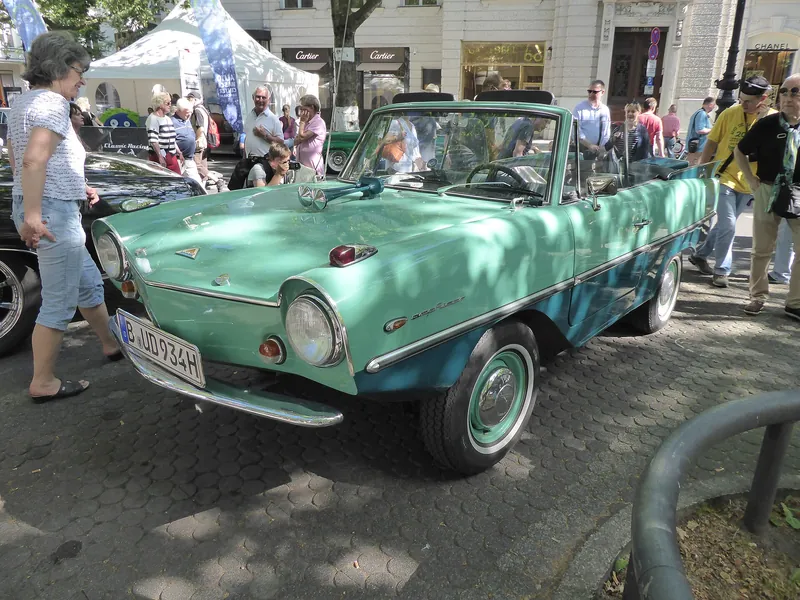
The International Amphicar Owners Club holds regional and national ‘swim-ins’, where owners meet, talk restoration and take their cars into the water. IAOC
Its national swim-in is held at Celina, Ohio, on Grand Lake St. Marys, during the Celina Lake Festival. Old Cars Weekly
In 2002, 64 Amphicars took turns splashing into the lake at Celina. The Daily Standard
For its 50th anniversary swim-in in 2018 the club hoped for 75 to 100 cars, and needed 72 to claim a Guinness world record for the most Amphicars in one place. Old Cars Weekly
Owners say there have been 911 calls about ‘a man in the water in his car’ for as long as there have been Amphicars. The Daily Standard
Where to see one
The Science Museum Group holds a 1967 Amphicar, registration KTR 133E, object 1973-408, given by Commander C. A. Coleman. Science Museum Group
The Lane Motor Museum in Nashville, Tennessee, has a 1964 Amphicar 770 in its collection. Lane Motor Museum
The TECHNOSEUM in Mannheim shows a 1968 Amphicar in its car-building section. TECHNOSEUM
Edle Oldtimer has photographed Amphicars at the Deutsches Technikmuseum in Berlin, the PS.Speicher in Einbeck, and museums on Rügen and at Syke-Okel. Edle Oldtimer
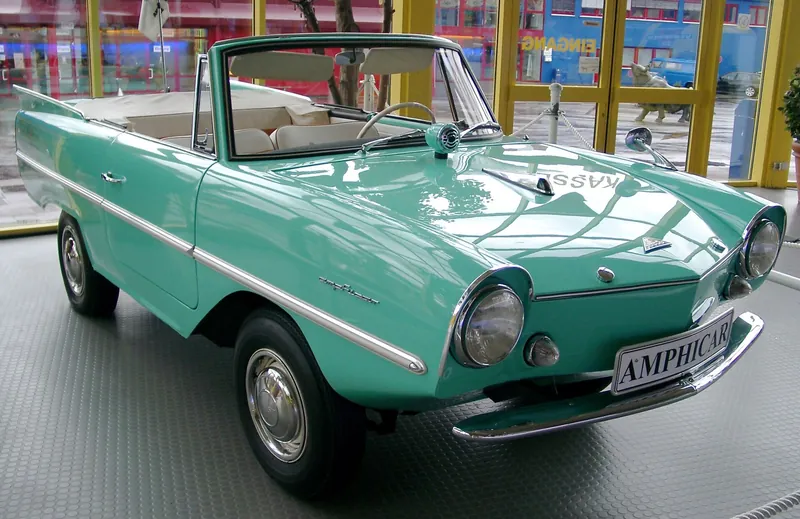
Displays change, so check with any museum before you visit.
After the Amphicar
Trippel never gave up: in 1989, aged 81, he showed one more amphibious prototype, the Aqua Terra. Der Spiegel, 2006
Gibbs’s Aquada, a 175 PS roadster, does 160 km/h on land and 50 km/h on water, and cost about 220,000 euros. Der Spiegel, 2006
Inspired by the Amphicar but underwhelmed by it in the water, two Californians designed the WaterCar Panther, a jet-driven amphibian that reaches 46 mph afloat. Hagerty, 2016
For two more unusual machines that cost their makers dear, see Chrysler’s turbine cars and the Sinclair C5 on their own motoring.im sites.
Timeline
- 1964 Der Spiegel’s 2006 article says it was all over by 1964, with 3,500 built. Der Spiegel, 2006
- 1965 The Science Museum Group gives production as 1961 to 1965. Science Museum Group
- 1965 The four men drove on by road and reached the Frankfurt motor show on 17 September 1965. Sky HISTORY
- 1967 Edle Oldtimer says the car was always a loss-maker that Harald Quandt tolerated, and that it was ended soon after he died in an air disaster in 1967. Edle Oldtimer
- 1968 Barrett-Jackson says the German factory closed for good in 1968. Barrett-Jackson The Berlin factory closed for good in 1968, and the leftover parts were bought by Hugh Gordon of Santa Fe Springs, California, whose Gordon Imports still supplies owners. IAOC history
- 1968 The Amphicar Club Berlin was founded in 1968 with 115 members, who still call each other ‘Sportskameraden’. Der Spiegel, 2006
- 1989 Trippel never gave up: in 1989, aged 81, he showed one more amphibious prototype, the Aqua Terra. Der Spiegel, 2006
- 2002 In 2002, 64 Amphicars took turns splashing into the lake at Celina. The Daily Standard
- 2004 The 1962 record stood until June 2004, when Richard Branson crossed in a Gibbs Aquada in about 90 minutes. Der Spiegel, 2006
- 2018 For its 50th anniversary swim-in in 2018 the club hoped for 75 to 100 cars, and needed 72 to claim a Guinness world record for the most Amphicars in one place. Old Cars Weekly
- October 2026 In October 2026 Hagerty’s price guide put a 1962 car in good condition at about $63,900. Hagerty price guide
Next: myths vs facts →