The Amphicar 770: the German convertible that drove into the water.
In 1961 a small German four-seat convertible went on sale in America with a Triumph engine at the back, two propellers under the tail and door seals like a refrigerator’s. You could drive it down a ramp, flick a second lever and carry on across the lake. Here is who built it, how it worked, how fast it really went, why it leaked, how many were made and which of the famous stories hold up, with every fact linked to its source.
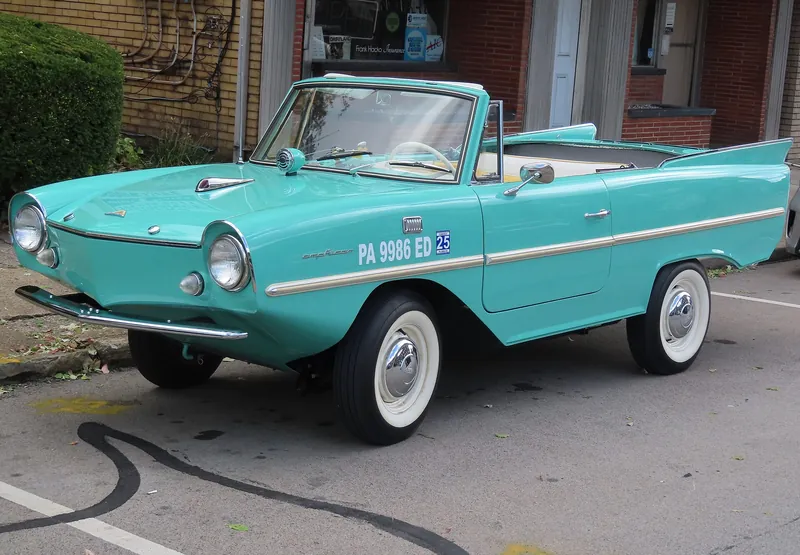
The Amphicar Model 770, not every car that swims. This site is about one machine: the small German amphibious convertible sold from 1961, mostly in the United States. It is not about wartime amphibians such as the Volkswagen Schwimmwagen or the American DUKW, or modern ones such as the Gibbs Aquada and the WaterCar Panther. They appear only as brief context.
Nor was it the first. Amphibious cars are almost as old as the car: Der Spiegel dates the first, the Magrelen Amphibium, to Denmark in 1899. Der Spiegel, 2006 It is not a buyer’s guide or a boating guide either: if you own an Amphicar, or want to take any vehicle into the water, ask an owners’ club and follow local boating rules.
The short version
The US National Park Service calls the Amphicar the only civilian amphibious passenger car ever to be mass produced, built in Germany from 1961 to 1968. National Park Service
It was designed by the German engineer Hans Trippel, who had been building amphibious vehicles since the 1930s. Hagerty UK Der Spiegel says the Amphicar came out of Trippel’s partnership with the industrialist Harald Quandt, and was built in Berlin and Lübeck. Der Spiegel, 2009
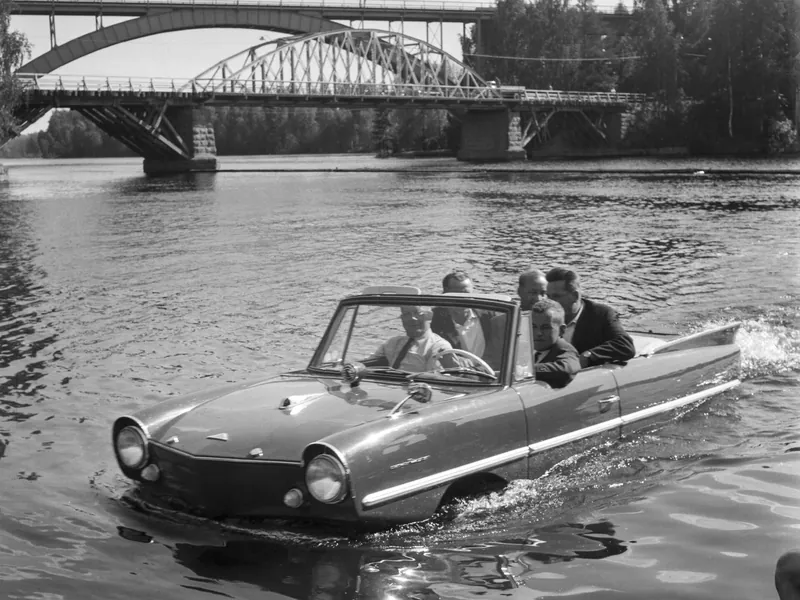
It had a rear-mounted four-cylinder engine from the British Triumph Herald, rated at 43 horsepower. IAOC history In the water it was driven by two nylon propellers, and the front wheels worked as rudders. IAOC history
The club’s history page says the name ‘Model 770’ came from a top speed of 7 mph on water and 70 mph on land. IAOC history
That name is the most disputed thing about the car: other sources say 7 knots, 8 knots or 12 km/h in the water, and land speeds from 65 to 90 mph. The on the water page sets them all out.
The owners’ club gives total production as 3,878, with 3,046 imported into the United States between 1961 and 1967. IAOC history
No 1968-model Amphicars were imported directly into the USA, because of new EPA and Department of Transportation rules for 1968 models. With the US taking about 90 per cent of sales, that was a financial disaster for the company. IAOC history
The owners’ club estimates that about 2,000 Amphicars still exist in some state, and repeats an owners’ guess that about 600 still swim. IAOC FAQ
Owners call it ‘the fastest car on the water and the fastest boat on the road’. Barrett-Jackson
Explore the story
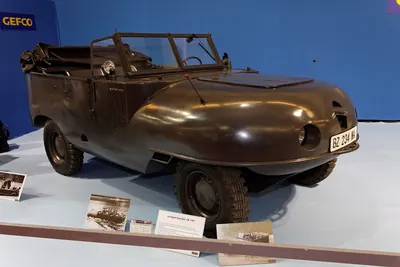 The storyHans Trippel, the Quandt money and two factories in Lübeck and Berlin.
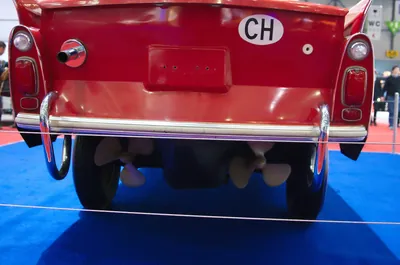 How it workedA Triumph engine, two gearboxes, two propellers and a lot of seals.
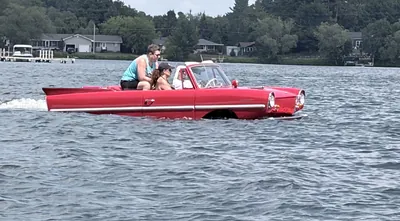 On the waterSpeeds, leaks, grease and the 1965 Channel crossing.
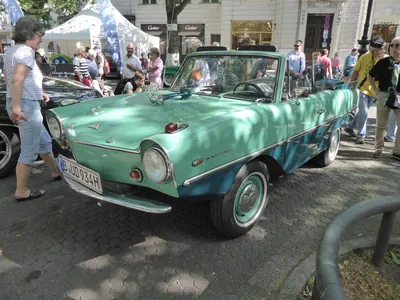 What happenedThe end in 1968, the numbers, and the owners who still swim them.
Tile pictures are credited on their pages and on the credits page.