Hans Trippel’s swimming car
A German engineer who had built floating cars since the 1930s, a family fortune, government money and a new British engine came together in the Amphicar.
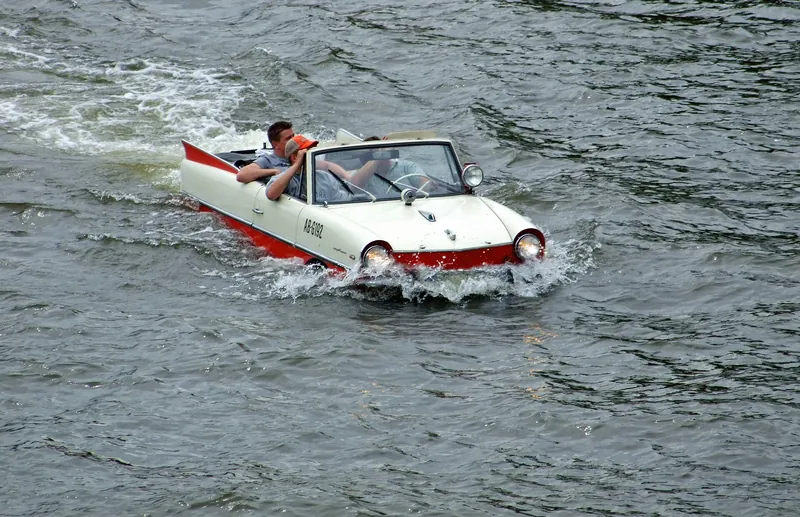
The Amphicar Model 770 of the 1960s. This site is about the German amphibious convertible, not amphibious vehicles in general. See the home page for what it leaves out.
Hans Trippel
Trippel was born in 1908 in Groß-Umstadt in Hesse, the son of a department store owner, and taught himself engineering. TECHNOSEUM
At 24 he borrowed 500 marks from his father, bought an old DKW and rebuilt it as his first floating car, the Land-Wasser-Zepp. TECHNOSEUM
On a test run in December 1934 the Zepp sank and Trippel had to swim back to the bank; three days later it was running again. TECHNOSEUM
Trippel had been a member of the Nazi party since 1930; in October 1936 he showed his vehicle to Hitler and received a 10,000 Reichsmark development grant. TECHNOSEUM
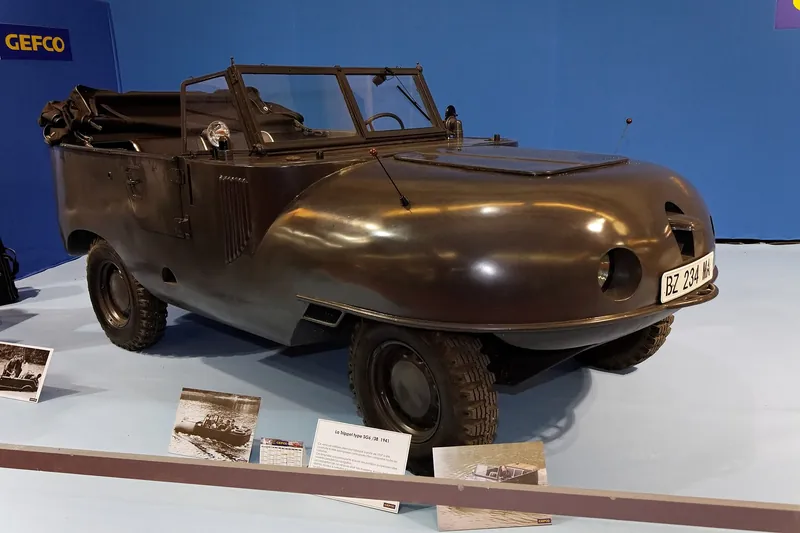
Der Spiegel notes that he was also a member of the SA, and that in 1938 he drove his SG6 amphibian to Naples and crossed by water to Capri. Der Spiegel, 2009
The war and after
In January 1941 the Trippel-Werke were set up in the former Bugatti works at Molsheim in Alsace, where more than 1,000 vehicles were built by 1945, along with aerial torpedoes and other arms. TECHNOSEUM
His wartime amphibians were made in far smaller numbers than Volkswagen’s Type 166 Schwimmwagen. Hagerty, 2016 More than 14,000 VW Schwimmwagen were built for the military, according to Der Spiegel. Der Spiegel, 2006
In 1947 a French court sentenced him, as a wartime armaments manager, to five years in prison; he was pardoned after three. TECHNOSEUM
Trippel’s Nazi party membership, his arms work and his prison sentence are part of the Amphicar’s story, and the sources we used do not hide them. He is also often credited with a famous piece of Mercedes design; we look at that claim on the myths page.
The Alligator
The TECHNOSEUM says Trippel built the prototype ‘Alligator’, from which the Amphicar was derived, in 1957. TECHNOSEUM
Hagerty UK says the prototype, called the Eurocar Alligator, was first shown at the 1959 Geneva show with a 948cc Austin A35 engine of 34 bhp. Hagerty UK
When was the prototype built? Sources differ
- The TECHNOSEUM says Trippel built the prototype ‘Alligator’, from which the Amphicar was derived, in 1957. TECHNOSEUM
- Hagerty UK says the prototype, called the Eurocar Alligator, was first shown at the 1959 Geneva show with a 948cc Austin A35 engine of 34 bhp. Hagerty UK
These need not clash: a prototype built in 1957 could have been shown in public at Geneva in 1959.
Der Spiegel’s 2006 account says the Quandt family, which also had a stake in BMW, came in after the Alligator was shown. Der Spiegel, 2006
Within months the new Triumph Herald arrived with a 39 bhp, 1147cc engine, and Trippel saw it as the compact, cheap and tough power he wanted. Hagerty UK
A German engine of the right kind was too expensive, according to Edle Oldtimer, so the Herald’s four-cylinder was chosen. Edle Oldtimer
Who paid?
Hagerty UK says Trippel persuaded the West German government that the car was a big export opportunity, and that millions of marks of public money went into its development. Hagerty UK
Hemmings simply calls it ‘backed by the German government’. Hemmings
Hagerty’s 2016 profile says IWKA, part of the Quandt group that had rescued BMW in the 1950s, began making the Amphicar in 1961, aimed mainly at North America. Hagerty, 2016
Hagerty’s price guide says some estimates put the money behind the project as high as $25 million. Hagerty price guide
Who was behind the money? Sources differ in emphasis
- Der Spiegel says the Amphicar came out of Trippel’s partnership with the industrialist Harald Quandt, and was built in Berlin and Lübeck. Der Spiegel, 2009
- Der Spiegel’s 2006 account says the Quandt family, which also had a stake in BMW, came in after the Alligator was shown. Der Spiegel, 2006
- Hagerty’s 2016 profile says IWKA, part of the Quandt group that had rescued BMW in the 1950s, began making the Amphicar in 1961, aimed mainly at North America. Hagerty, 2016
- Hagerty UK says Trippel persuaded the West German government that the car was a big export opportunity, and that millions of marks of public money went into its development. Hagerty UK
- Hagerty’s price guide calls the backers ‘the American Quandt Group’. Hagerty price guide
Every source points to the Quandt family’s businesses and Harald Quandt in particular, with public money on top. Only Hagerty’s price guide calls the Quandt group American; the other sources describe a German industrial family. We have not seen accounts that show how much each side put in.
Where it was built
The owners’ club says the cars were assembled in Lübeck and later Berlin by Industrie-Werke Karlsruhe (IWK), a subsidiary of DWM, the post-war name of the firm that once made the Luger pistol. IAOC FAQ
Production began in 1961 at IWK’s works in Lübeck-Schlutup and in Berlin-Borsigwalde, and every car’s tub-shaped body was tested for leaks before delivery. Edle Oldtimer
From autumn 1962, because of state subsidies for West Berlin, assembly was concentrated at the DWM works in Berlin-Borsigwalde, with bodies still coming from Lübeck. Edle Oldtimer
The Berlin-Brandenburg business archive says the cars were built in the old Deutsche Waffen- und Munitionsfabriken halls on the Eichborndamm in Wittenau, where the archive itself is now housed. Berlin-Brandenburg business archive
The Martin Auto Museum says the bodies came from Italy, with assembly in Berlin and Lübeck; we found no other source that says so. Martin Auto Museum
Lübeck, Berlin, or Italy? Sources differ
- The owners’ club says the cars were assembled in Lübeck and later Berlin by Industrie-Werke Karlsruhe (IWK), a subsidiary of DWM, the post-war name of the firm that once made the Luger pistol. IAOC FAQ
- From autumn 1962, because of state subsidies for West Berlin, assembly was concentrated at the DWM works in Berlin-Borsigwalde, with bodies still coming from Lübeck. Edle Oldtimer
- The Martin Auto Museum says the bodies came from Italy, with assembly in Berlin and Lübeck; we found no other source that says so. Martin Auto Museum
Most sources describe production in Lübeck and Berlin, moving to Berlin from autumn 1962. Only one museum page mentions Italian bodies; we have treated it as unconfirmed.
Launch and price
Edle Oldtimer says a pre-production car was shown at the New York motor show as early as 1960 to test the American market. Edle Oldtimer
Hagerty’s price guide says the car first surfaced at the 1959 German motor show and came ashore in the US on 1 April 1961, at the New York Auto Show. Hagerty price guide
A US company, the Amphicar Corporation of America, was set up to sell it. IAOC FAQ
The makers planned at least 25,000 cars, mostly for the American market. Der Spiegel, 2006
Hagerty UK says the hope was to build 20,000 a year. Hagerty UK
The owners’ club puts the plan at ‘something like 30,000’, against just under 4,000 sold. IAOC FAQ
How many did they plan to build? Sources differ
- The makers planned at least 25,000 cars, mostly for the American market. Der Spiegel, 2006
- Hagerty UK says the hope was to build 20,000 a year. Hagerty UK
- The owners’ club puts the plan at ‘something like 30,000’, against just under 4,000 sold. IAOC FAQ
The figures are not strictly comparable: 20,000 is a yearly hope, the others are totals. All of them dwarf the fewer than 4,000 actually made.
In Germany it cost 10,500 marks at first and, from April 1963, 8,385 marks; in the US it was first offered at $3,395. Edle Oldtimer That was about the price of two Volkswagen Beetles. TECHNOSEUM
Hagerty’s price guide says the US price of $3,395 came down to $2,695 in 1964, about what a new Mustang convertible cost. Hagerty price guide
Hagerty’s 2016 profile says instead that the price rose from $2,800 to $3,200 by the end of sales, nearly double a Beetle. Hagerty, 2016
The owners’ club says new cars sold for $2,800 to $3,300 depending on the year, and that later years cost less than early ones. IAOC history
What did it cost in America? Sources differ
- Hagerty’s price guide says the US price of $3,395 came down to $2,695 in 1964, about what a new Mustang convertible cost. Hagerty price guide
- Hagerty’s 2016 profile says instead that the price rose from $2,800 to $3,200 by the end of sales, nearly double a Beetle. Hagerty, 2016
- The owners’ club says new cars sold for $2,800 to $3,300 depending on the year, and that later years cost less than early ones. IAOC history
The three accounts disagree on whether the price went up or down. Without dated price lists we cannot settle it; the range of about $2,700 to $3,400 covers them all.
Selling it
The club’s president told Hagerty that Trippel meant it as an everyday car, and that adverts aimed it at women and showed families picnicking by rivers. Hagerty, 2016
All Amphicars were convertibles, first offered in four colours: Beach Sand White, Regatta Red, Lagoon Blue and Fjord Green. IAOC history
Besides the four colours there was at least one black car, some emerald green ones for the Berlin police, and 50 ivory cars with red tops for Cypress Gardens and the 1964 World’s Fair. IAOC FAQ
Hamburg’s water police ran three Amphicars. Der Spiegel, 2006
A few were built as emergency rescue vehicles, and buyers could order an anchor, flares, paddles, a fire extinguisher and even a shower worked by the bilge pump. IAOC FAQ
Welt am Sonntag called them in 1964 ‘the only civilian land and water cars in the world’. Berlin-Brandenburg business archive
Hagerty UK lists film and TV appearances including The Sandwich Man, Rotten to the Core and The Avengers. Hagerty UK
For where the Amphicar fits among West Germany’s other cars, see Germany’s place in car history on history.motoring.im.
Timeline
- 1908 Trippel was born in 1908 in Groß-Umstadt in Hesse, the son of a department store owner, and taught himself engineering. TECHNOSEUM
- December 1934 On a test run in December 1934 the Zepp sank and Trippel had to swim back to the bank; three days later it was running again. TECHNOSEUM
- October 1936 Trippel had been a member of the Nazi party since 1930; in October 1936 he showed his vehicle to Hitler and received a 10,000 Reichsmark development grant. TECHNOSEUM
- January 1941 In January 1941 the Trippel-Werke were set up in the former Bugatti works at Molsheim in Alsace, where more than 1,000 vehicles were built by 1945, along with aerial torpedoes and other arms. TECHNOSEUM
- 1947 In 1947 a French court sentenced him, as a wartime armaments manager, to five years in prison; he was pardoned after three. TECHNOSEUM
- 1957 The TECHNOSEUM says Trippel built the prototype ‘Alligator’, from which the Amphicar was derived, in 1957. TECHNOSEUM
- 1959 Hagerty UK says the prototype, called the Eurocar Alligator, was first shown at the 1959 Geneva show with a 948cc Austin A35 engine of 34 bhp. Hagerty UK
- 1 April 1961 Hagerty’s price guide says the car first surfaced at the 1959 German motor show and came ashore in the US on 1 April 1961, at the New York Auto Show. Hagerty price guide
- 1961 Production began in 1961 at IWK’s works in Lübeck-Schlutup and in Berlin-Borsigwalde, and every car’s tub-shaped body was tested for leaks before delivery. Edle Oldtimer
- Autumn 1962 From autumn 1962, because of state subsidies for West Berlin, assembly was concentrated at the DWM works in Berlin-Borsigwalde, with bodies still coming from Lübeck. Edle Oldtimer
- April 1963 In Germany it cost 10,500 marks at first and, from April 1963, 8,385 marks; in the US it was first offered at $3,395. Edle Oldtimer
- September 1965 The four men drove on by road and reached the Frankfurt motor show on 17 September 1965. Sky HISTORY