A car built like a boat
A watertight steel body, an engine at the back, two gearboxes and a pair of propellers. Here is how the Amphicar went from road to water and back.
The Amphicar Model 770 of the 1960s. This site is about the German amphibious convertible, not amphibious vehicles in general. See the home page for what it leaves out.
The body
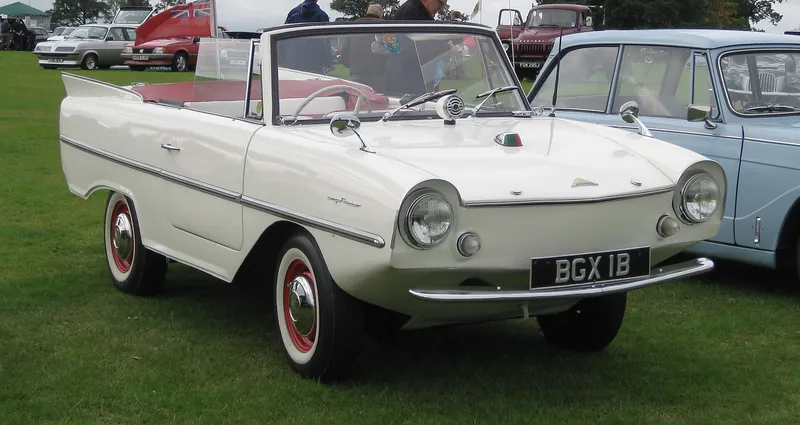
The Lane Motor Museum describes a steel unitary two-door convertible body with electrically welded joints, the engine at the back driving the rear wheels. Lane Motor Museum
Trippel insisted on steel rather than glassfibre, and on extra-thick panels to stand up to waves, which made the car rigid but heavy. Hagerty UK
Edle Oldtimer describes the body as a self-supporting all-steel shell, stiffened with a twin-tube frame, that could be sealed watertight. Edle Oldtimer
The engine sat behind the rear axle and the gearbox ahead of it; on the road it drove the rear wheels. Edle Oldtimer
Barrett-Jackson explains the rear engine as a boat-builder’s choice: it kept the engine’s weight from pulling the nose under. Barrett-Jackson
Hagerty gives its weight as 2,300 pounds. Hagerty price guide
Edle Oldtimer gives 1,050 kg with oil, water and fuel, and a length of 4,330 mm. Edle Oldtimer Edle Oldtimer gives the wheelbase as 2,100 mm and the width as 1,565 mm. Edle Oldtimer
Transportation History calls it a two-seater. Transportation History
Hagerty’s price guide calls it a four-seat convertible. Hagerty price guide
The car had a rear seat as well as the front one (the engine sits under it), and the photographs on this site show passengers in the back, so we follow the museums and clubs and call it a four-seater.
The engine
It had a rear-mounted four-cylinder engine from the British Triumph Herald, rated at 43 horsepower. IAOC history
Edle Oldtimer gives the Herald engine as 1,147 cc, 38.3 PS at 4,750 rpm, with one Solex carburettor and pushrod valves. Edle Oldtimer
Der Spiegel’s 2006 article gives 38 PS and ‘1200 cc’. Der Spiegel, 2006
How powerful was it? Sources differ
- It had a rear-mounted four-cylinder engine from the British Triumph Herald, rated at 43 horsepower. IAOC history
- Edle Oldtimer gives the Herald engine as 1,147 cc, 38.3 PS at 4,750 rpm, with one Solex carburettor and pushrod valves. Edle Oldtimer
- Der Spiegel’s 2006 article gives 38 PS and ‘1200 cc’. Der Spiegel, 2006
- Within months the new Triumph Herald arrived with a 39 bhp, 1147cc engine, and Trippel saw it as the compact, cheap and tough power he wanted. Hagerty UK
These are mostly the same engine measured in different units: American sources quote 43 gross horsepower, German ones 38 PS, and Hagerty UK gives the Herald’s 39 bhp. Der Spiegel’s “1200 cc” is a rounding of the 1,147 cc everyone else gives.
Because the engine was British, German owners needed imperial-sized tools as well as metric ones. Edle Oldtimer
The electrics were a Lucas 12-volt positive-earth system, with some parts by Hella and Bosch. IAOC history
For how a four-stroke engine works, see engines.motoring.im.
Two gearboxes
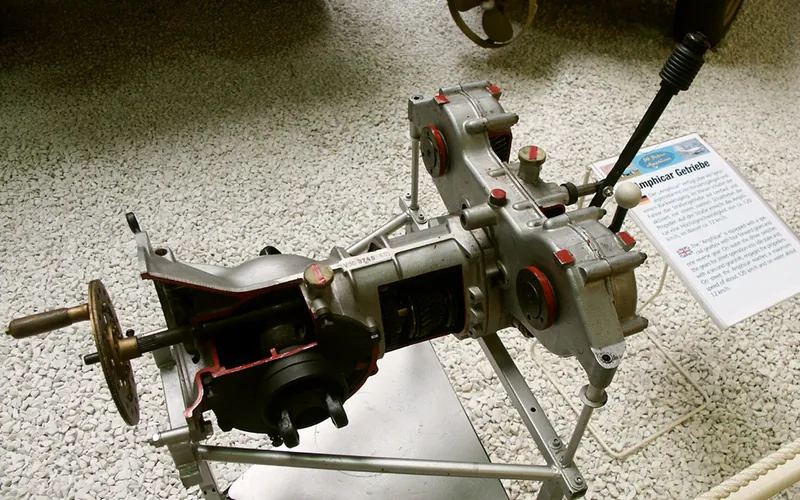
Its two-part land and water gearbox was built by Hermes, and let the wheels and propellers be driven separately or both at once. IAOC history
The land gearbox had four speeds and reverse, rather like an old Volkswagen Beetle’s; the water gearbox had just one forward and one reverse gear. IAOC history
Edle Oldtimer describes it as a modified four-speed Hermes gearbox with a central gear lever, from the Tempo works of Vidal in Hamburg. Edle Oldtimer
Hagerty describes a power take-off from the four-speed gearbox that turned the twin propellers, forwards or backwards. Hagerty, 2016
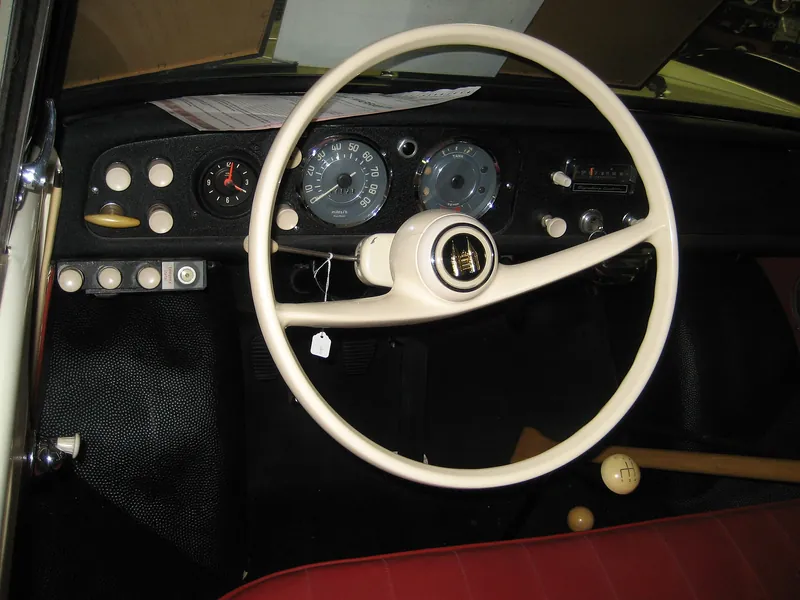
There were two gear levers on the floor: one for the four-speed land gearbox and one for forwards and reverse on the propellers. IAOC FAQ
For more on gears and gearboxes, see engines.motoring.im.
Propellers and steering
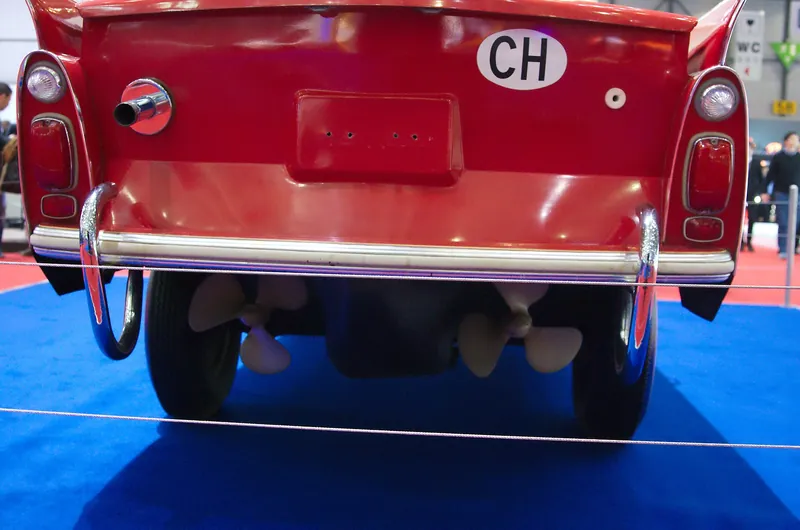
In the water it was driven by two nylon propellers, and the front wheels worked as rudders. IAOC history
The propellers were three-bladed and made of plastic, one either side of the engine. Edle Oldtimer
Keeping the water out
Each door had rubber seals that pressed against seals on the frame, and a second handle inside pulled the door tighter shut. IAOC FAQ
The club compares the two door seals to a refrigerator’s, and says separate water locks stopped anyone opening a door afloat. IAOC FAQ
Hemmings describes a two-stage door seal with a second lock at the bottom of the door, a mild-steel welded body, a high-capacity electric bilge pump and waterproof seats. Hemmings
An electric bilge pump pumped out any water that splashed or leaked in. IAOC FAQ
US cars also had a timed bilge blower that cleared fumes from the hull before the engine would start, as US rules required on inboard motorboats. IAOC FAQ
It floated with about 21 inches of freeboard; the front bumper sat just above the water and the tail a little lower, because of the rear engine. IAOC FAQ
Hagerty says the 21 inches of freeboard were meant to stop a passing speedboat’s wash from swamping it, and that the height needed for that hurt its handling on the road. Hagerty price guide
Those fins
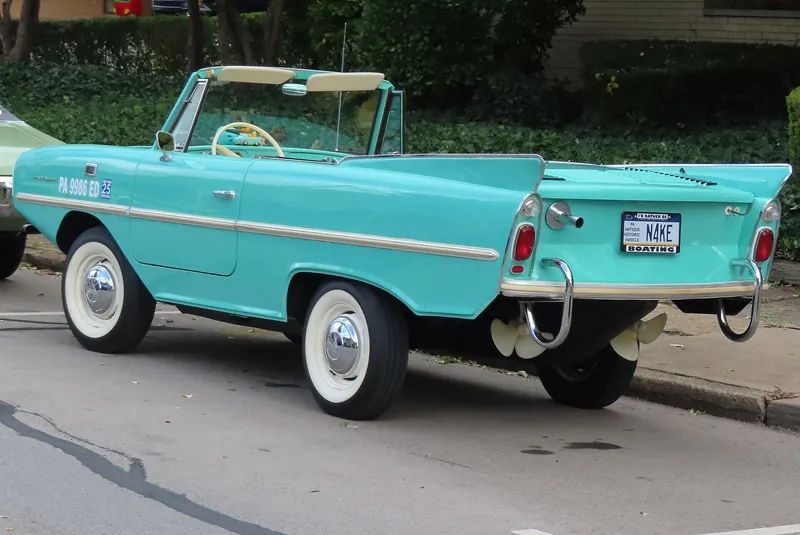
Hagerty UK calls its rear fins the tallest of any production car, and says they were needed to stop water pouring through the engine-lid louvres. Hagerty UK
The Lane Motor Museum says the fins stand one inch higher than a 1959 Cadillac’s. Lane Motor Museum
Der Spiegel adds that the fins kept waves coming from the side out of the engine. Der Spiegel, 2006
A boat as well as a car
It carried boat navigation lights, and Hemmings says oars and life jackets were optional extras. Hemmings
On the front lid it had a navigation light and a horn; on the rear lid, a white light and a small flag mast. Edle Oldtimer
Hagerty says the US Coast Guard recognised it as a legitimate boat. Hagerty price guide
The anchor, oar and fenders lived in the front boot. Der Spiegel, 2006
Under the rear seat cushion was a plywood board, and under that the engine; owners say it gets hot and vibrates. Der Spiegel, 2006
The knobs on the dashboard worked the lights, wipers and so on, and none of them was labelled. IAOC FAQ
Its smooth hull and 10 inches of ground clearance made it good in snow, and a low first gear let it climb ramps as steep as 37 per cent. Hemmings
Next: on the water →