Into the lake, and across the Channel
Driving in was the easy part. Here is how you steered and stopped it, how fast it really went, what leaked, what rusted, and how two Amphicars crossed the English Channel in 1965.
The Amphicar Model 770 of the 1960s. This site is about the German amphibious convertible, not amphibious vehicles in general. See the home page for what it leaves out.
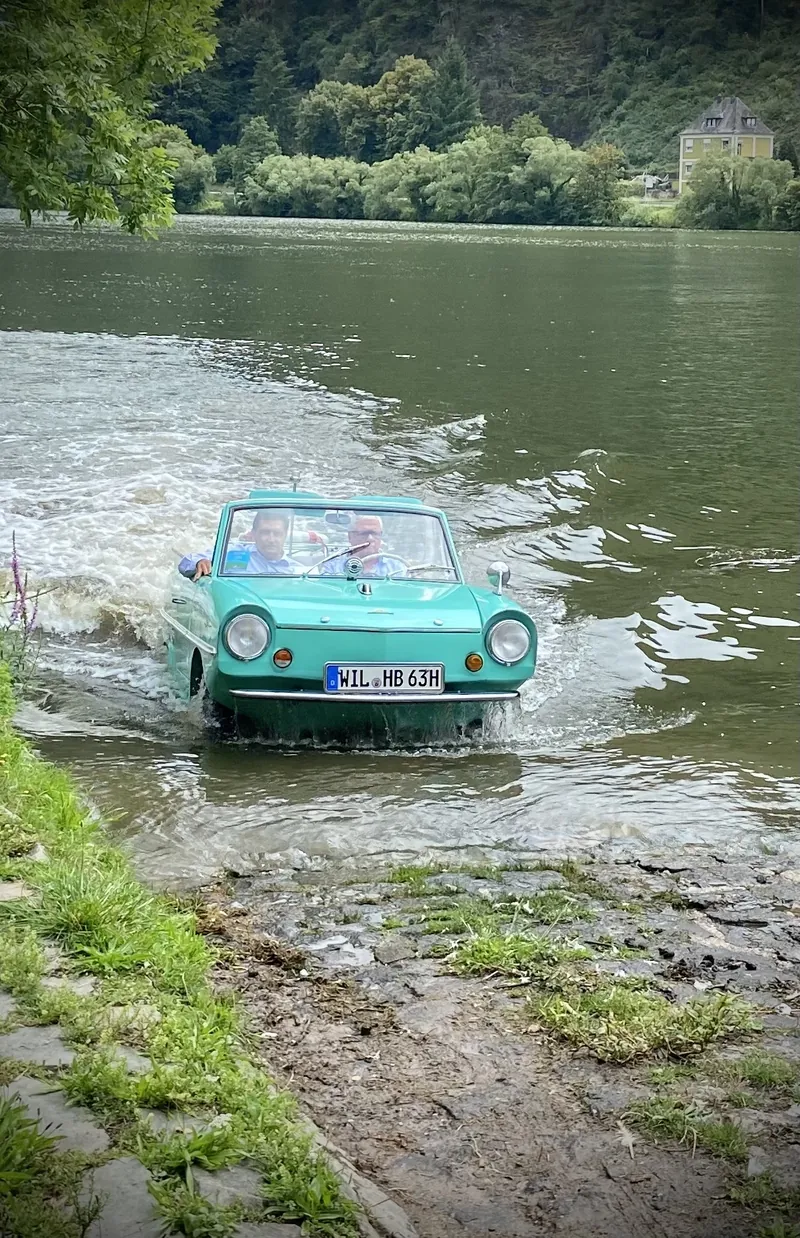
Going in
To go in, you shut the doors, check that the bonnet and the bilge plug are secure, and drive down to the water. IAOC FAQ
Der Spiegel’s reporter describes the moment of going in: the nose dips, water washes over the bonnet towards the windscreen, and you lift your feet without meaning to, until the car levels out and floats. Der Spiegel, 2006
Once afloat you put the land gearbox in neutral and engage the propellers with the small second lever. IAOC FAQ
Hemmings says both drives could be used together when landing. Hemmings
Steering and stopping
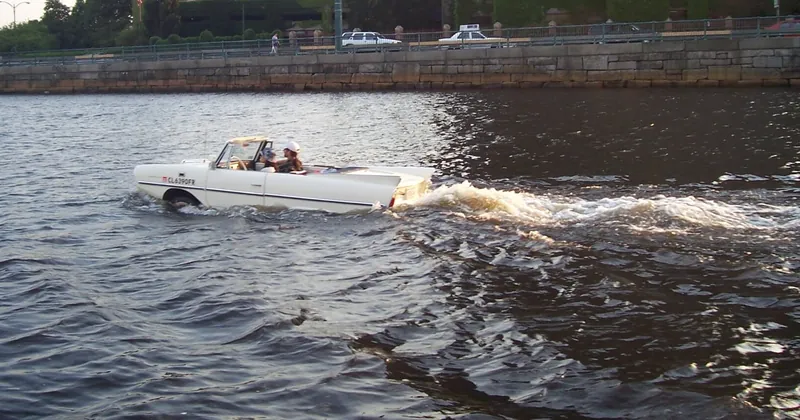
Steering afloat is with the front wheels, which made it harder to manoeuvre than a boat. Der Spiegel, 2006
The owners’ club says first-time helmsmen often remark how responsive the steering feels in the water. IAOC FAQ
Afloat, the brakes do nothing: you stop the way any boat does, by putting the propellers into reverse. IAOC FAQ
Der Spiegel puts it more bluntly: no stamp on the brake pedal, however brave, will stop an Amphicar in the water. Der Spiegel, 2009
What did 770 mean?
The owners’ club FAQ says only that ‘it is said’ the 770 stood for 7 knots (about 8 mph) in the water and 70 mph on land. IAOC FAQ
The same FAQ later gives about 70 mph on land and about 6 knots (7 mph) in the water, ‘in spite of’ what some early adverts claimed. IAOC FAQ
The club’s history page says the name ‘Model 770’ came from a top speed of 7 mph on water and 70 mph on land. IAOC history
Top speed in the water: sources differ
- Hagerty UK gives the name as 7 knots in the water and 70 mph on land. Hagerty UK
- Hemmings also says 7 knots (8 mph), and adds that some sources claimed a top speed as high as 85 mph. Hemmings
- Hagerty’s 2016 profile says the name meant 7 mph on water and 70 on the road. Hagerty, 2016
- Barrett-Jackson says 7 mph, ‘or 6 knots’, on water and 70 mph on land. Barrett-Jackson
- Sky HISTORY says 7 mph in the water and 70 on land, ‘in theory, at least’. Sky HISTORY
- The Lane Motor Museum gives about 6½ knots (7 mph) in the water and 68 mph on land, with 70 mph in its specification. Lane Motor Museum
- The Science Museum Group gives 70 mph on land and a ‘more leisurely’ 7 mph on water. Science Museum Group
- Edle Oldtimer says the 770 meant 7 miles in the water and 70 on the road. Edle Oldtimer
- Its own data table gives 113 km/h on the road and 12 km/h in the water. Edle Oldtimer
- Der Spiegel in 2006 gave just under 120 km/h on the road and 8 knots on water. Der Spiegel, 2006
- Der Spiegel in 2009 gave 105 km/h at most on land and at best 12 km/h in the water. Der Spiegel, 2009
- The TECHNOSEUM gives 120 km/h on land and 12 km/h on water. TECHNOSEUM
- The Berlin-Brandenburg business archive gives 125 km/h on land and 7 knots in the water. Berlin-Brandenburg business archive
The name is a neat story, but the sources split between 7 knots and 7 mph, which differ by about 15 per cent. The German sources mostly give 12 km/h, which is close to 7 mph. The owners’ club itself prefers about 6 knots, and says it cruises at 8 to 10 mph with the current. All agree it was far too slow to pull a water skier.
It also says an Amphicar cruises at about 8 to 10 mph, depending on the current: not enough to pull a water skier. IAOC FAQ
And on land
Hagerty’s price guide says the listed top speed was 90 mph but road testers managed only about 65; 0 to 60 mph took 43 seconds, and it cruised at about 10 mph in the water. Hagerty price guide
Car and Driver, as quoted by Hagerty, called the ride billowy and wobbling, the steering vague, and said the brakes ‘required the strength of Hercules’. Hagerty price guide
The owners’ club says most stock Amphicars can still cruise all day at 60 to 65 mph, ‘until they come to a hill’. IAOC FAQ
On land it can do 35 mpg or more; on water it uses about 1 to 1.5 gallons an hour. IAOC FAQ
Did it leak?
In TIME’s 2007 list of the 50 worst cars, Dan Neil wrote that it was not particularly watertight, and that its flotation depended on whether the bilge pump could keep up with the leaks. TIME
Neil also allowed that it was reasonably agile on land and fairly manoeuvrable on water, if painfully slow. TIME
Der Spiegel says passengers regularly reported water getting in and wet feet. Der Spiegel, 2009
The Berlin-Brandenburg business archive describes the bilge pump as there to pump out the ‘little water’ that usually got in. Berlin-Brandenburg business archive
Can one sink? Yes, says the owners’ club, like any boat that takes on more water than it weighs; but it says that is not common, and that the cars are very seaworthy despite their early bad press. IAOC FAQ
The club’s joke answer to ‘how deep can it go?’ is ‘all the way to the bottom if you forget the bilge plug’. IAOC FAQ
Grease and rust
After time in the water, Edle Oldtimer says, thirteen grease nipples had to be refilled. Edle Oldtimer
A Berlin owner told Der Spiegel there are 32 grease nipples, and that they need fresh grease after every five hours in the water. Der Spiegel, 2006
Hemmings says the maker’s routine after each swim included taking out the rear seat and greasing more than a dozen points, and that many owners skipped it. Hemmings
How many grease points? Sources differ
- After time in the water, Edle Oldtimer says, thirteen grease nipples had to be refilled. Edle Oldtimer
- A Berlin owner told Der Spiegel there are 32 grease nipples, and that they need fresh grease after every five hours in the water. Der Spiegel, 2006
- Hemmings says the maker’s routine after each swim included taking out the rear seat and greasing more than a dozen points, and that many owners skipped it. Hemmings
Thirteen, “more than a dozen” and 32 may count different things: points to grease after every swim, or every grease point on the car. All three agree it was a chore.
Cars used in salt water tended to rust. Hemmings
Hagerty’s price guide warns that any car used in salt water rusted badly, so a proven history matters. Hagerty price guide
The same Berlin owner blamed American owners who left their cars in the water all summer and found them full of mussels, with the joints rusted solid, by autumn. Der Spiegel, 2006
Licences and paperwork
In Germany a driver needed two licences, one for the road and one for inland waters, and the rules limited where it could be used away from public roads. Edle Oldtimer
Berlin Amphicars carry boat registration numbers; before 1990 they were registered with the shipping directorate in Hannoversch Münden. Der Spiegel, 2006
Stories from the water
In July 1965 Die Welt reported a Norwegian tanker, the Acina, meeting an Amphicar on the Elbe at Teufelsbrück. Berlin-Brandenburg business archive
Die Welt also suggested running the bilge pump in a traffic queue if someone was too close behind: a thumb-thick jet of water would land on their bonnet. Berlin-Brandenburg business archive
On a 1978 holiday on the Adriatic, a Berlin owner’s loaded car took a wave into the engine, which stopped; the anchor dragged in the mistral, and the family rowed and motored back through heavy water. Der Spiegel, 2006
The owners’ club says two Amphicars travelled 350 miles down the Yukon in Alaska in 1968. IAOC FAQ
Hagerty UK says one Isle of Wight resident bought an Amphicar to cross to the mainland rather than pay ferry fares. Hagerty UK
TIME noted that during floods in Britain an Amphicar owner used his car as a water taxi, taking water and groceries to stranded schoolchildren. TIME
Across the Channel
Der Spiegel says two Frenchmen crossed the English Channel in an Amphicar in 1962, in five hours and 50 minutes. Der Spiegel, 2006
It adds that two English cars tried three years later, and that one took in water halfway and had to be towed, the trip taking more than seven hours. Der Spiegel, 2006
The 1965 crews were two army officers, Captain Michael Bailey of the Royal Electrical and Mechanical Engineers and Captain Peter Tappenden of the Royal Army Ordnance Corps, in one car, and Sergeant Joe Minto of the Royal Army Service Corps with the escape artist Timothy Dill-Russell in the other. Transportation History
They drove down a ramp into Dover harbour at 8.50 in the morning and landed north of Calais at 4.30 in the afternoon. Transportation History
Transportation History calls the four men the first people to cross the Channel in cars. Transportation History
Who crossed first? Sources differ
- Der Spiegel says two Frenchmen crossed the English Channel in an Amphicar in 1962, in five hours and 50 minutes. Der Spiegel, 2006
- Transportation History calls the four men the first people to cross the Channel in cars. Transportation History
Der Spiegel describes a 1962 crossing by two Frenchmen; the English-language sources we found say nothing about it and call the 1965 crews the first. We have not found a 1962 newspaper report to settle it.
Hagerty UK says they set out in force 3 winds that rose to force 6 mid-Channel. Hagerty UK
The owners’ club says the crossing was made in ‘20-foot seas and gale-force winds’. IAOC FAQ
One car’s bilge pump clogged with debris, its engine stalled when the electrics flooded, and the other car towed it; the towing car needed refuelling at sea. Hemmings
Backfire News says the refuel was done by dropping the hood and filling the tank in the nose through a makeshift snorkel, and that a ferry made the crossing in 90 minutes. Backfire News
Hemmings says they made land seven hours and 20 minutes after leaving Dover. Hemmings
How rough was it, and how long did it take? Sources differ
- Hagerty UK says they set out in force 3 winds that rose to force 6 mid-Channel. Hagerty UK
- The owners’ club says the crossing was made in ‘20-foot seas and gale-force winds’. IAOC FAQ
- Hemmings says they made land seven hours and 20 minutes after leaving Dover. Hemmings
- They drove down a ramp into Dover harbour at 8.50 in the morning and landed north of Calais at 4.30 in the afternoon. Transportation History
Force 6 on the Beaufort scale is a strong breeze, short of a gale; “20-foot seas and gale-force winds” is a bigger claim, and it comes from the club’s own retelling. The times differ by twenty minutes depending on when each source starts and stops the clock.
The four men drove on by road and reached the Frankfurt motor show on 17 September 1965. Sky HISTORY
Transportation History gives the road leg to Frankfurt as about 375 miles. Transportation History
The 1962 record stood until June 2004, when Richard Branson crossed in a Gibbs Aquada in about 90 minutes. Der Spiegel, 2006